
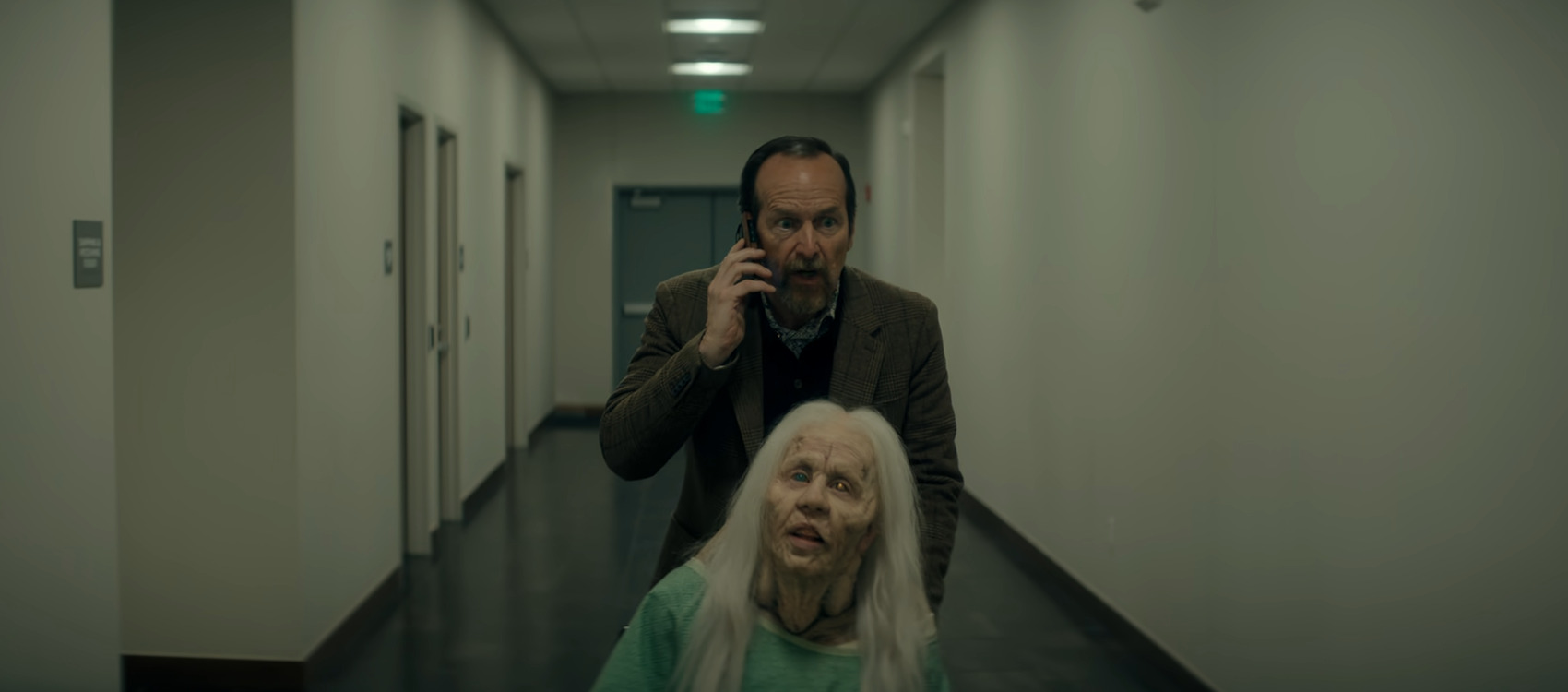
When most viewers finished The Eternaut, they walked away with a straightforward assumption: Mother is an alien entity, a powerful extraterrestrial intelligence whose death marks the end of the invasion.
But what if the show is pointing somewhere very different?
A growing fan theory argues that Mother isn’t meant to be understood as an alien at all. Instead, she’s a modern sci-fi reinterpretation of the Phoenix, the mythical bird associated with death, rebirth, and eternal cycles. Under this reading, the series’ final moments are not about destruction. They’re about transformation.
The theory becomes surprisingly convincing once you stop viewing Mother through the lens of science fiction and start examining her story as mythology disguised as sci-fi.
What initially looks like an alien life cycle begins to resemble one of humanity’s oldest legends.
The Evidence
Mother Emerges From an Egg, Just Like a Mythological Birth
One of the most obvious clues is also the easiest to overlook.
Mother’s emergence is framed through imagery associated with hatching and birth. Rather than arriving as a conventional extraterrestrial invader descending from space, she emerges from an egg-like structure.
In classic science fiction, eggs usually signal reproduction. In mythology, however, eggs often symbolize creation, resurrection, and divine rebirth.
The Phoenix itself is frequently associated with cyclical rebirth from ashes or sacred nests. Various ancient traditions describe the Phoenix’s life beginning anew through a ritualized cycle of death and emergence.
The show’s decision to introduce Mother through imagery of hatching feels unusually symbolic if she is merely another alien species.
It makes far more sense if the writers are intentionally invoking mythological archetypes.
She Appears Functionally Immortal
Throughout the series, Mother is portrayed as something fundamentally different from ordinary life forms.
She is not simply powerful. She seems eternal.
Characters repeatedly struggle to understand her nature because she operates outside normal biological rules. Her existence feels ancient, almost timeless.
That aligns remarkably well with Phoenix mythology.
Across Greek, Egyptian, and later literary traditions, the Phoenix is often described as an immortal being that never truly dies. Instead, it passes through recurring cycles of destruction and renewal.
If Mother is a Phoenix figure, her apparent immortality isn’t a superpower.
It’s her defining characteristic.
The story repeatedly treats her as a force of nature rather than a creature, which is exactly how mythological beings are often portrayed.
She Must Return to the Cave Before Death
One detail that stands out near the end is Mother’s apparent need to return to a specific location before dying.
Rather than perishing randomly, she returns to her place of origin, the cave.
This is an oddly ceremonial choice.
Most alien invasion stories focus on strategic objectives. Villains die where they’re defeated. Their deaths are practical.
Mother’s journey feels ritualistic.
Many Phoenix legends describe the creature returning to a sacred location, nest, or birthplace before undergoing its death-and-rebirth cycle. Death is not an accident but a necessary stage in a predetermined process.
Viewed through that lens, Mother’s return to the cave resembles a pilgrimage.
She isn’t retreating.
She’s preparing for the next phase of her existence.
Her Death Is Literally a Phoenix Death
The strongest piece of evidence comes from the way Mother dies.
The scene is not presented as a conventional death. Instead, she self-destructs in a brilliant explosion of light and energy.
The imagery is strikingly similar to the traditional Phoenix myth.
The Phoenix does not simply die. It burns.
Fire is central to nearly every version of the legend. The creature is consumed in flame before being reborn from the remains.
Mother’s destruction follows the same symbolic pattern.
The visual emphasis isn’t on violence or defeat. It’s on radiance, transformation, and release.
The scene almost invites viewers to think of a Phoenix, even if the show never says the word aloud.
The Final Glitch Suggests Rebirth, Not Extinction
The most important clue may be the final moments of the series.
After Mother’s apparent death, viewers witness a subtle glitch or disturbance that suggests something remains unresolved.
If the writers intended Mother to be permanently destroyed, this moment serves little purpose.
But if her story follows the Phoenix cycle, the glitch suddenly becomes crucial.
A Phoenix is never gone.
Every death contains the seed of another beginning.
The ending’s ambiguity feels less like a sequel tease and more like confirmation that the cycle is starting again. The story deliberately refuses to give viewers finality because finality would contradict the mythology being referenced.
Mother’s death only matters if rebirth follows.
The glitch hints that it already has.
What This Could Mean
If Mother is truly a Phoenix figure rather than a traditional alien, several aspects of the story take on new meaning.
First, the invasion may never have been intended as a conquest. It could be part of a recurring cosmic cycle that repeats across generations, worlds, or civilizations.
Second, Mother may not be the villain at all. Phoenix figures are often agents of transformation rather than evil. The destruction surrounding her could be a consequence of renewal rather than a deliberate act of malice.
Third, the ending becomes significantly less tragic. Instead of witnessing a creature’s death, viewers are witnessing the completion of a cycle that has happened countless times before.
The story’s final image stops being an ending and becomes a beginning.
The Counterargument
The strongest argument against this theory is straightforward.
The show clearly presents Mother as an alien organism. The narrative is built around extraterrestrial threats, strange biology, and science fiction concepts. Nothing explicitly identifies her as a Phoenix or references Phoenix mythology by name.
That’s true.
The series never abandons its sci-fi framework.
But symbolic storytelling rarely works through direct statements. Writers often borrow mythological structures while keeping characters grounded in science fiction settings.
Many famous sci-fi stories are secretly retellings of ancient myths. The mythological layer exists beneath the surface narrative rather than replacing it.
The Phoenix theory doesn’t require Mother to literally be a magical bird.
It only requires the writers to have modeled her life cycle on the Phoenix archetype.
The evidence suggests they may have done exactly that.
Verdict
Confidence Rating: 7.5/10
The theory cannot be proven outright, but the parallels are difficult to ignore. Mother’s emergence from an egg, her apparent immortality, her return to her birthplace, her fiery death, and the final hint of rebirth all mirror core elements of Phoenix mythology.
Whether she’s technically an alien or not may be the wrong question. The more interesting possibility is that the show uses an alien character to tell a much older story, one about death, renewal, and an eternal cycle that never truly ends.
If Mother is destined to be reborn, was her death actually the end of the threat, or did the series quietly show us the first moments of the next cycle beginning?